
Design will save your product?
AI makes more things possible. Knowing what to build still takes more than any one discipline can offer.
When all you have is a hammer, everything looks like a nail. But sometimes there really is a nail and all you have is a drill. So you bang the drill against the nail. Someone watching suggests you’re getting distracted. “What you’re actually trying to do is join two pieces of wood. Have you considered glue?” He sells glue.
If you work in tech and open LinkedIn, you won’t have to scroll far before someone points out that yes, AI makes building easier, but it doesn’t help you decide what to build. Don’t fret. That’s where their particular area of expertise comes in handy.
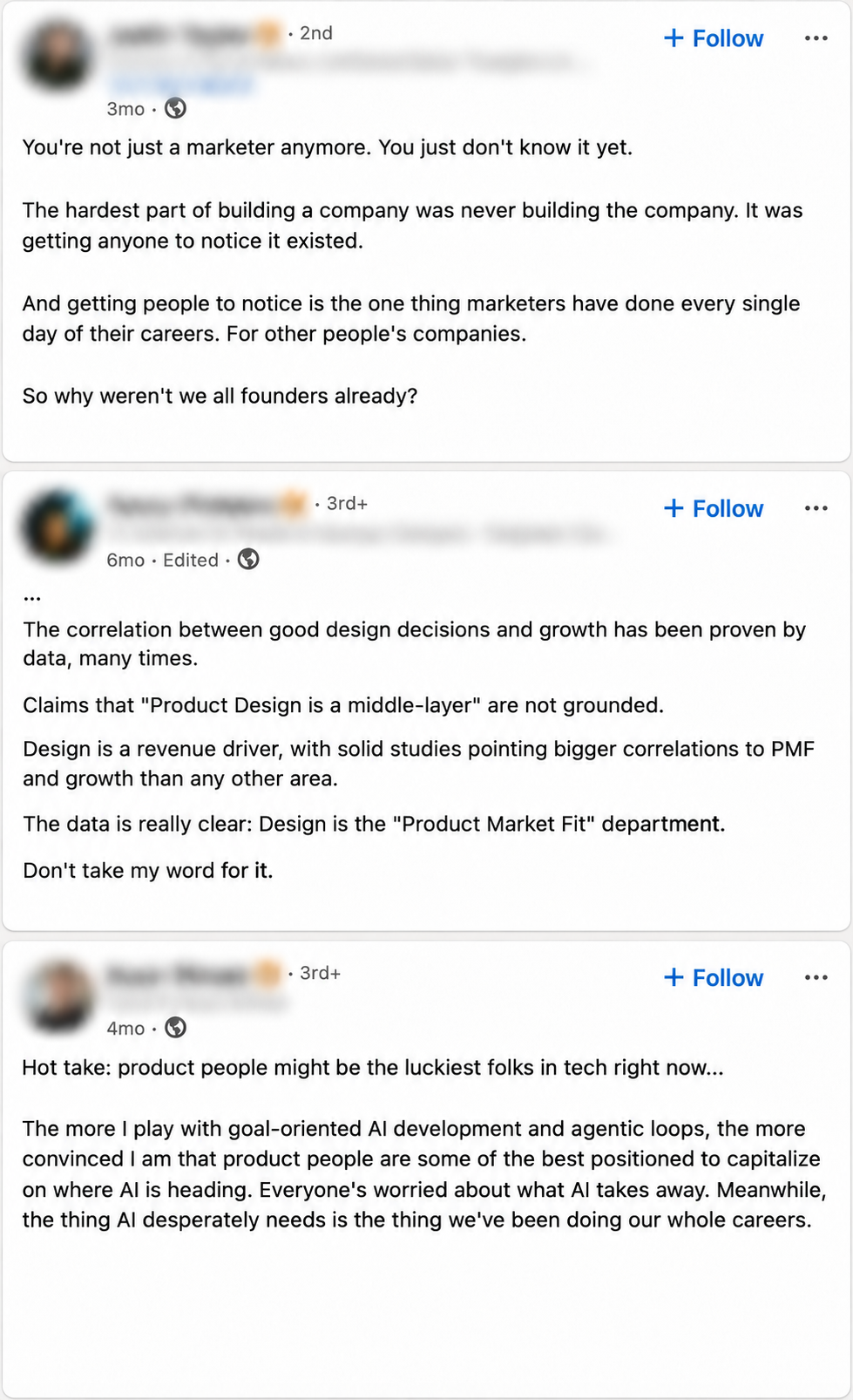
- Marketing: “The hardest part of building a company was never building the company. It was getting anyone to notice it existed.”
- Design: “Design is the ‘Product Market Fit’ department.”
- PM: “…the thing AI desperately needs is the thing we’ve been doing our whole careers.”
It’s comforting to discover that the secret weapon in the AI product development race is [insert your job title].
The annoying thing is, they’re all right.
Your product might need better design, a clearer idea of who it’s for, a better business strategy, a way to reach people, or all of the above. Which matters most depends on the product, the market and what’s happening around them.
If there were a reliable playbook for building successful products, we’d all be following it. I certainly would. I’d quite like a few apps quietly generating piles of money and millions of delighted customers. So far, it’s been a little more complicated than that.
I should know. I’m a designer.
As a designer, I found the design argument particularly convincing. I’d spent years in big tech researching what people needed, helping shape product strategy and designing experiences for millions of users.
On the American Express mobile team, I saw global usage double and mobile overtake the web channel’s share of digital usage. Design contributed. So did engineering, marketing and the business teams. Mobile use was also growing in general. I’d love to take credit for everyone who started using the app. I suspect some would have turned up anyway.
But looking back at that success, design was the part that stood out to me. So when AI made it possible for me to build a fully functioning product myself, I knew exactly what would make it successful. DESIIIIGN.
A few years earlier, I’d had a shower thought about stepping into someone else’s algorithm. I’d spent hours bloop blooping through Netflix suggestions, YouTube wormholes and Apple Music’s “Made for You.” I was sick of myself. I wanted to live in someone else’s feed for a while.
When AI coding tools became usable enough for me to try, I started building Cthru. It was a music app where people could shape their recommendations and share them with each other. The interface came easily. The rest gave me a new appreciation for my former colleagues.
Building is the easy part. Right?
One challenge was capturing someone’s musical taste and using it to generate radio stations. I built a system that processed artist biographies and album reviews through OpenAI’s API, turning the descriptions into mathematical representations I could use to find related music.
This was considerably more sophisticated than using the genre tags already attached to songs, artists and albums. It was also considerably more random.
Making better sense of those existing tags produced more coherent recommendations. But I’d spent time building a complicated approach without enough experience to judge whether it was a good one. An engineer or data scientist would have brought ways to evaluate the results and question the approach, along with the ability to build it.
At Google, I’d worked on enterprise products where delivering accurate, reliable functionality was substantial work. “Building is the easy part” depends very much on what you’re building. My little music app was giving me a reminder.
With design, I could question AI’s suggestions against years of experience. With recommendation algorithms and data pipelines, I was learning enough to work out what to question.
Zero divided by three
Then there was the business model. AI and I brainstormed charging for access to popular accounts. We also considered putting all account sharing behind a paywall, which raised an awkward problem. The app needed people sharing their taste to make it interesting. Charging everyone for that might leave very little to discover.
Perhaps influencers could receive a share of the revenue from people paying to access their accounts. Then I needed a price that would cover Apple’s fees, the influencer’s share and the infrastructure running the app, with something left over.
Before anyone had paid us anything, we were already figuring out how to divide the money.
We could research comparable services, work through costs and produce plausible proposals. But I had no experience selling a music discovery service, and AI wasn’t bringing firsthand experience of doing it either. We were asking people who already paid for music to pay again for a different way of finding it.
What would make that worth paying for? What would persuade a creator to participate? Where could I charge without discouraging the activity the app needed? I wanted someone who had dealt with those tradeoffs in a real business. Someone who could help me work out which assumptions to test before I built the payment system.
Even a price that looks unreasonable can be part of the appeal. Rory Sutherland’s Alchemy is full of examples of people responding to products in ways that complicate an otherwise perfectly reasonable plan.1
Take Red Bull. A smaller can for more money sounds like something we should fix. Give people more. Charge them less. Surely we can agree on that.
Sutherland argues that the smaller can helps change the comparison. It suggests a different category of drink, rather than a worse deal on an ordinary soft drink.2 The size, price and positioning work together.
Whose victory is that supposed to be? Packaging design? Marketing? Pricing? I imagine several departments could put it in their end-of-year presentation.
That interaction was what made Cthru’s business model difficult. A paywall was a revenue decision, but it could also change how much people shared and what other users found when they arrived. I couldn’t neatly finish the product and then hand the remaining questions to marketing.
Users sold separately
After a few months, I had a functioning app and released a beta to friends and family. That group surfaced some useful insights. I still needed to get it in front of strangers.
In my research with AI, online advertising came up as unlikely to be effective. Then I spoke to a product leader who said ads had worked very well for their app. That left me with more useful questions about the audience, the offer and what they had actually tried.
AI also suggested guerrilla marketing tactics I have yet to employ. They required dedicated effort while I was still building the app. I’d never marketed anything, and I wasn’t particularly excited to become good at it. I was considerably more excited about my next app idea.
AI had plenty of suggestions for getting the app in front of people. Unfortunately, they involved me getting the app in front of people.
This is another thing a collaborator brings. Someone with marketing experience would have opinions about which tactics deserved a test. They might also want to do that test while I was finding excellent reasons to keep building.
There are plenty more apps arriving, too. Research highlighted by a16z tracks new releases across iOS, Android and Chrome. Releases increased sharply as coding agents emerged, but the activity those apps attracted in their first three months didn’t keep pace.3 More of us can put an app on the shelf. Getting someone to pick it up remains another job.
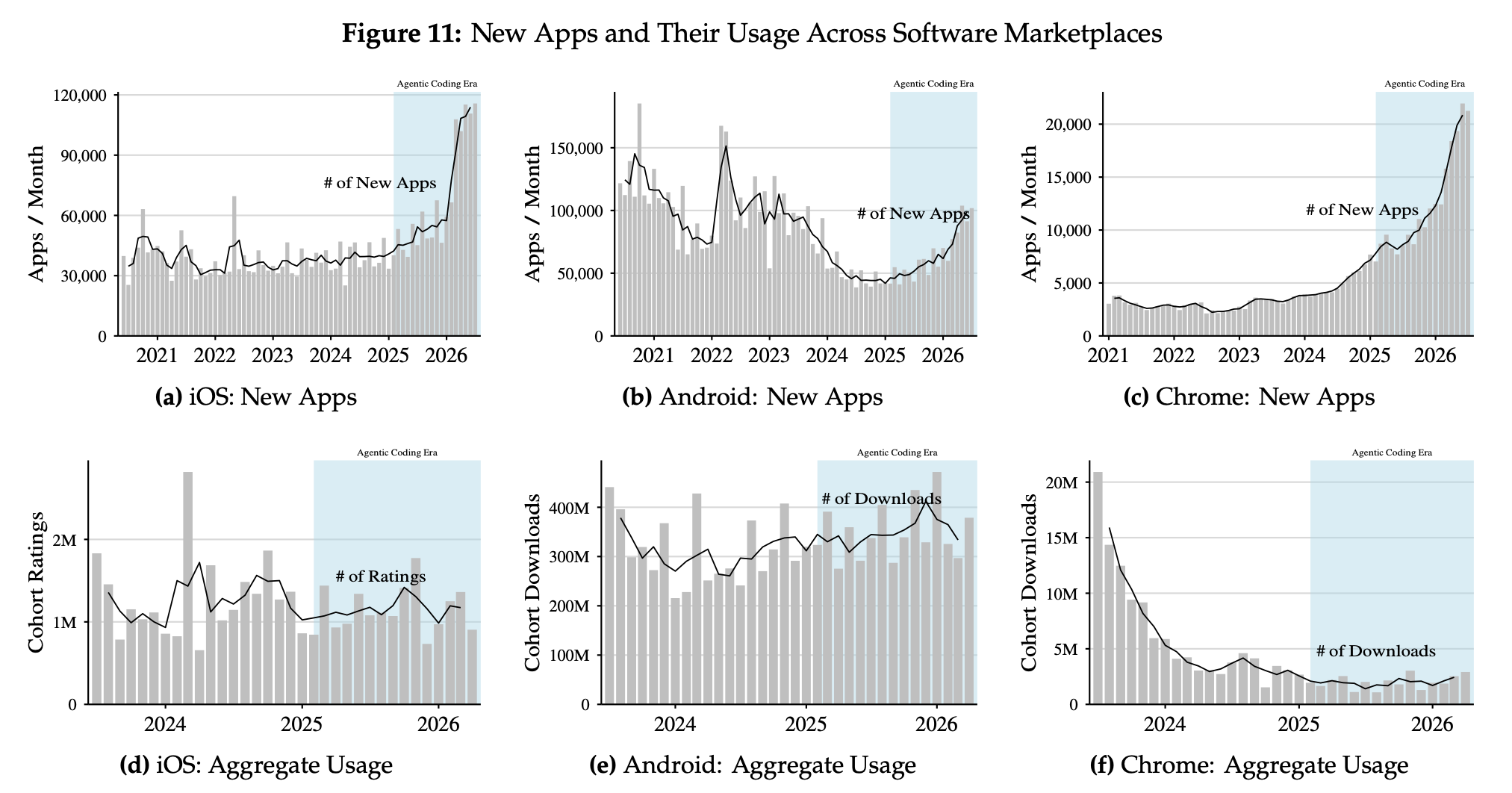
New releases above; activity in their first three months below, measured through iOS ratings and Android/Chrome downloads. The blue shading begins in February 2025. First two rows of Figure 11 in Demirer, Musolff and Yang, as discussed by a16z.3
I’d like to speak to a human
I’ve built a few other apps and websites since then. Now I’m looking for ways to bring more people into the process. I’ve reached out to a trusted friend about collaborating because I miss bouncing ideas off a real human being.
I miss people bringing their own experience to a problem. The engineer who recognizes an approach they’ve already struggled with. The marketer who’s actually persuaded someone to try an unfamiliar product. People who get interested in the parts I keep putting off, and whose ideas can change what we’re making.
Having those people around never guaranteed success. We could do the research, follow established processes and still get disappointing results. But somewhere in my enthusiasm for doing everything myself, I’d underestimated how much their thinking had shaped mine.
AI has made it possible for me to build things I couldn’t have built before. I’d also managed to become the entire meeting. No wonder we kept agreeing to build another feature.
References
Footnotes
-
Rory Sutherland, Alchemy: The Surprising Power of Ideas That Don’t Make Sense, first published 2019. ↩
-
Rory Sutherland, “Accountability Is Not Enough”, Market Leader, January 2012 issue; web page dated July 9, 2012. See the “Framing” section. ↩
-
Moses Sternstein, “Charts of the Week: So Many Apps, So Little Time”, September 18, 2026. Chart and underlying research from Mert Demirer, Leon Musolff and Liyuan Yang, “Writing Code vs. Shipping Code: Productivity Effects Across Generations of AI Coding Tools”, September 6, 2026, section 7.2 and Figure 11. ↩ ↩2